Wednesday, January 9, 2013

Welcome to our Traditional Martial Arts School in East Valley

Yokoso! Welcome!

We are all looking forward to meeting you at our traditional martial arts school in the East Valley of Phoenix (Mesa, Chandler, Gilbert). All of our deshi (students) become friends because of the traditional training methods and many become friends for life. You will find our traditional martial arts school with many features from Okinawan karate schools.

Soke Hausel (Kyoku) at the University of Wyoming.
Imagine training with Kyoku no Budo (Professor of Martial Arts) who taught martial arts, traditional karate, kobudo (martial arts weapons), self-defense, jujutsu and samurai arts at the University of Wyoming for 3 decades and also taught karate and kobudo at Arizona State university, University of New Mexico and the University of Utah.  Our head instructor is also the world head of Seiyo No Shorin-Ryu Karate Renmei, an international martial arts association based in Mesa, Arizona. Soke (Grandmaster of Karate) is a member of several Halls-of-Fame for his teaching technques and martial arts training, and is the highest ranked martial artist in the world in Shorin-Ryu Karate and Kobudo (Seiyo Kai).  At the rank of Junidan in Shorin-Ryu Karae and Kobudo, awarded on December 7th, 2012, he is placed in the unique position of being able to award ranks from beginner to the highest rank avaible in karate.

Soke is not only a tremendous Grandmaster, he has been recognized for many contributions to teaching including Grandmaster of the Year, International Grandmaster of the Year, Instructor of the Year and International Instructor of the Year.


To find our martial arts school, drive east on Baseline from Country Club. Turn left at the second traffic light at MacDonald, and you will see us at the NE corner.
So when you train at our dojo (martial art school), you will be exposed the best possible instruction.


Like Us on Facebook to learn more about classes, styles and people in Shorin-Ryu Karate & Kobudo in Arizona as well as in the world.

You can learn more about the Arizona Hombu and our International Training Center in Mesa, Gilbert, Chandler, Arizona


Sunday, April 15, 2012

Arizona-Utah Black Belts Train in Hanbojutsu

Luis from Utah performs Ago Senage on Todd during black belt clinic in Mesa, Arizona


Members of the Utah Shorin-Kai and Arizona School of Traditional Karate trained in Hanbojutsu (半棒) at the Seiyo Shorin-Ryu Hombu in Mesa Arizona (April 12-14th, 2012) under the direction of Grandmaster (Soke) Hausel, 10th dan (十段). The training reviewed several waza (techniques) including chokes, strikes, blocks, restraints and throws (nage waza) and Soke Hausel taught several new techniques that the group had never seen before. The hanbo, known as the Half-Bo can be a very effective weapon as it is a stick about the length of a cane and can be carried essentially anywhere and is considered part of the Kobudo Program at the Arizona Hombu.

Renshi Stoneking applies royote garumi on Luis during hanbo training at
Arizona School of Traditional Karate in Mesa.

Ryan applies  koshi ori ni kata on Thad at the Arizona School of Traditional Karate, in Mesa Arizona during the Utah-Arizona Black Belt Clinic. High ranking martial artists from Murray and Salt Lake City Utah trained with martial artists from Gilbert, Mesa and Chandler, Arizona in the ancient Japanese art of Hanbo jutsu along with Shorin-Ryu Karate and Kenjutsu.

Wednesday, December 7, 2011

FOX NEWS visits ARIZONA SCHOOL OF TRADITIONAL KARATE

Our Hombu Dojo in Mesa across from Gilbert, was recently visited by Fox News. 

The Fox 10 news team stopped by our Hombu dojo to meet two of our black belt students and learn about TRADITIONAL OKINAWA SHORIN-RYU KARATE and KOBUDO. The team indicated they were very impressed by the techniques, power and focus of the Shorin-Ryu Karate students and reported this was the most powerful karate they had ever seen in Arizona and were also very impressed by the students they interviewed.


We are hoping to get a copy of the Fox 10 video that had been promised to us, but for now, feel free to watch some of our YOUTube videos. The interview was conducted by Richard Saenz. If you would like to see the video, please contact Richard Saenz at Fox 10 Phoenix.


Monday, February 14, 2011

ABOUT Arizona Shorin-Ryu Karate and Kobudo


ABOUT US - SEIYO NO SHORIN-RYU KARATE KOBUDO KAI


Seiyo Kai International evolved from traditional Shorin-Ryu Karate and was officially recognized as a unique martial art in 1999. Thus this style, a gendai (現代武道) (modern) art, evolved from a koryu (古流) (old-school) martial art. Our members (Seiyo Kai International) train in basics (kihon) of karate and kobudo which are taught over and over again (but in different ways) to teach muscle memory to attain a level of mushin (無心) (a disconnect from the mind). If a deshi (内弟子) (student) trains without full focus and effort, the training will leave negative imprints on the muscles and the student will learn to defend with little force as is seen in most Western martial arts schools. "You defend as you train". Look around your dojo (道場) and watch not only your sensei (先生), but also those who exhibit power. These people are training properly – try to emulate their effort.


In addition to kihon (基本)(fundamentals), members of Seiyo Shorin-Ryu practice kata ()(forms) and bunkai (分解)(applications). We have a curriculum that includes more than 70 kata. Why so many? Kata and karate (空手) are inseparable. This has been emphasized by great Okinawan Shorin-Ryu masters of the past and we agree. Kata is extremely important since kata includes basics, balance, stances, breathing, self-defense (bunkai), and timing & distancing (in Japanese, known as 'ma'). Everything we need is found in kata. Katas should also be practiced with distinct timing in mind with breaks (places where techniques are slow and emphasized, where they accelerate, etc), they should be practiced with focus while keeping bunkai in mind: they should never be rushed. The practice of kihon and kata mixed with bunkai provides excellent training as long as one includes power, focus and Zen philosophy. Traditional karate requires traditional methods.

Yan Ma demonstrates Pinan Godan Kata
Competition in martial arts is antipathetic to what we look to achieve. The great Okinawan master of karate, Gichin Funakoshi (1868-1957) wrote "The ultimate aim of karate lies not in victory or defeat, but in perfection of its participants".

It is clear from Funakoshi's and other Okinawan masters that karate was designed for self-improvement and never designed for tournament competition. If anything, most tournaments bring about just the opposite of what karate is trying to teach. We do not stop our students from competition - we believe in free choice, instead it is up to the individual. But tournaments reward martial artists for technique that is useless and flashy, it rewards martial artists for holding back power and focus, and it periodically rewards people for improper behavior.

Even so, in the past. some of our members were awarded regional, national and even international championships. But this has to do with the type of martial arts training required for competition and its philosophy. If you ever have a chance to watch a tournament, most competitors have little focus. A few years ago, the University of Wyoming club experimented with competition and nearly every member who competed won a medal (or was disqualified in kumite competition for striking too hard); however, those who continued in this adventure lost essentially all of their focus and power within a year. We do not stop anyone from competing – this is a freedom of choice, but it will likely end up with the deshi developing poor technique.

Sensei Linton of Wellington, CO defends against tanto
(Knife) attack from Hanshi Finley of Casper, WY at Seiyo
Clinic at the University of Wyoming in Laramie.

We practice controlled ippon kumite (sparring). But, free sparring must be kept to a bare minimum and only introduced to students when they acquire a good level of focus, power and control. When I introduce students to kumite, it is primarily ippon kumite (one step sparring). In this situation, uke (defender) is attacked by tori (attacker). Sometimes the attack is predetermined, other times it is not. When we practice kumite, our sensei must watch closely for lack of focus. When the focus is lost, we need to practice the technique again and again with focus.


Charles and Ryan train in kama bunkai
At rare times free sparring (jiyu kumite) is practiced under the watchful eyes of a sensei. Free sparring is practiced to teach deshi to respond without thinking. As soon as any block, kick, or punch is applied without focus, the practitioner must be stopped and the same scenario practiced over and over again until it is done with focus. Most karate schools in the US concentrate on free sparring and this is one of the principal sources for bad technique in most schools. So free sparing needs to be controlled and limited greatly.

Hanshi Finley is all tied up during
hojojutsu training at the Casper
dojo. This is an art used by local
offcials to restrain prisoners in
the Edo period of Japan.
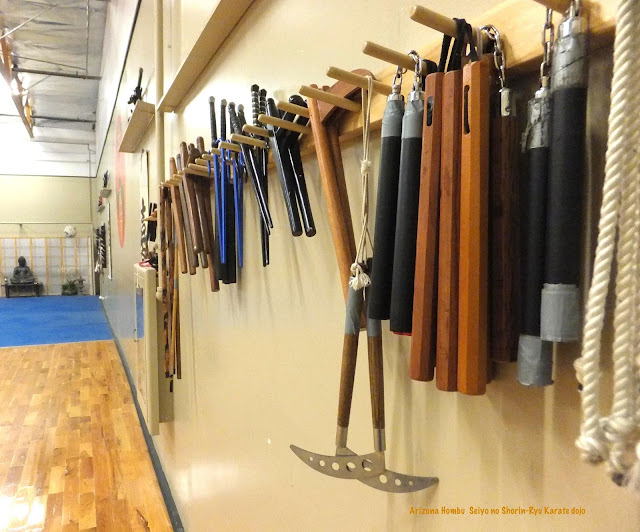
Along with karate (empty hand) training, Seiyo Shorin-Ryu students learn kobudo – the art of ancient weapons. Weapons in our curriculum include bo (6-foot staff), hanbo (half-staff), kobuton (short stick), nunchaku, sai, tonfa, kibo (expandable baton), kuwa (hoe), kumade (rake), kuai (cane), kama, nitanbo, iku (oar), manrikigusari (weighted chain), surichin (weighted rope), nireki (two rakes), hari (fish hook), tekko (knuckle duster), kusarigama (sickle & chain) and others.


Seiyo Shorin-Ryu members also have the unique privilege of learning Samurai arts including iaido, naginatajutsu, jujutsu, sojutsu, bojutsu, and hojojutsu. These arts include training with katana (samurai sword), tanto (knife), naginata (pole arm), yari (spear), hojo (cord) and jujutsu.


Sketch of Gichin Funakoshi (船越 義珍)
Self-defense training is very important and we train in defense against a variety of attacks. When a new technique is introduced tori (the attacker) must begin by give and take until uke (defender) learns the technique, then tori should become more aggressive to provide more resistance and speed, but always keeping in mind safety and self-confidence issues. Tori must also remember that he or she is not being struck with an actual atemi (distracting strike) that assists uke in escapes. Our association also provides self-defense training for the lay-person through clinics and classes.


Deshi Harden uses tekubi waza on Shihan-
Dai Dr. Adam during training at Hombu in
Mesa, Arizona
Sooner or later, all of our students break rocks. This is a very minor part of karate, but a confidence builder. After teaching karate for more than 40 years, I’ve only had one student unable to break a rock – it was a barrier that this person built for herself and could not overcome even though this person was capable. When breaking boards, we do not pick plywood to break (or tree limbs), so with rocks, we look for good flat, limestone and/or sandstone. So in a sense, it helps to be a geologist.


For a few students, special miegakure (hidden) techniques are taught including kotekitae (kotekikai) (body hardening) and tein hsueh (vital point strikes) are taught to help us master hitotsuki hitogeri (one strike one kick knockouts).


The majority of classes taught at the Arizona School of Traditional Karate, also known as our Seiyo Shorin-Ryu Hombu are taught to adults and families. Each of our dojos is different: some focus on families, others on adults, and some have kid’s classes and some have a mix of classes.


Shihan Gewecke of the Gillette, Wyoming dojo breaks rocks
during our Spring geology 101 training at the University of
Wyoming in Laramie.

Tuesday, May 19, 2009

CLASS SCHEDULE @ ARIZONA HOMBU

 
Our training center is open to the public - we focus on Adults and Families. Come learn the traditions of Okinawan Karate & Kobudo. Much of the class is conducted in both Japanese and English to help students learn Japanese. We also teach meditation, philosophy and martial arts history interjected in karate classes. Our schedule and fees are found on our websites.

Ryan Harden shows his power in blocks at the
Arizona School of Traditional Karate in Mesa,
Gilbert and Chandler in the East Valley of Phoenix


I'm a Local Sponsor on MerchantCircle


The Arizona Hombu in Mesa is a traditional Japanese koryu dojo and World Training Center for Shorin-Ryu Karate & Kobudo (Seiyo-Kai). Managed by Grandmaster (Soke) Hausel, 10th dan. Soke celebrates his 45th anniversary as a martial artist (2009). Soke is also a JKI samurai & kyoju (professor of martial arts). Come join us in the SUN in ARIZONA


We have members from all over the world who travel to Mesa to train in this traditional Okinawan style. Soke Hausel emphasizes power in technique, focus, kata (forms), bunkai (applications of every technique in every kata) & kobudo (ancient Japanese weapons) as well as modern kobujutsu (modern common garden tools in self-defense).


Soke Hausel recently opened the Arizona Hombu for training for his Arizona students and his international members around the US. He works with the business community offering classes, clinics and seminars to benefit people in self-confidence, self-defense and health. His classes in Women's Self-Defense have been very popular over the past 35 years and he recently initiated clinics in training airline travelers and airline hostesses in self-defense applications in close quarters using wrist locks, pressure points, chokes and seat belts for restraining and defending against aggressive passengers and terrorists.
 

Other groups who have taken advantage of training from Soke Hausel include EMT, Nurse, Military, ROTC, Teachers, Women, Church, Airline Companies, Seniors, Scientific and Engineering groups and companies. Soke Hausel, being a well-known scientist, easily relates to these groups.

These groups rent the hombu for their own classes & one must contact them directly for information. Information on Soke’s Shorin-Ryu Classes, or how your business can set up special clinics or classes, contact Soke Hausel.


Our class schedule is listed on our websites at (1) Arizona Karate, and (2) Seiyo Shorin-Ryu. Groups and organizations can schedule their own times or clinics or join in the regular classes.


People of all ages (6 to 90) from the Mesa-Gilbert-Chandler-Tempe (Phoenix area) come to train in the TRADITIONAL (non-competitive) arts of Okinawan Shorin-Ryu karate and kobudo. And members of our international organization - Seiyo Kai International come from around the world to train in our dojo under the International Instructor of the Year - Grandmaster Hausel. Visit My Website


As a member of the Arizona Hombu, you can learn karate, self-defense, jujutsu, restraints, nunchuku, kama, yari, sai, tonfa, kioga, hanbo, bo, naginata, manrikigusari, tanto, katana, nitanbo, kobuton, eku, ra-ke, tsune and more.

MAP


How to find us - we are located at the NE corner of MacDonald and Baseline in Mesa right at the Mesa-Gilbert city line. Look for Walmart - we are just to the east.


VISITORS

VISITORS The Hombu attracts visitors from around the globe for training - these are often international karate teams, members of Seiyo Kai International, individuals & business groups looking to keep their employees healthy and provide them with self-defense training.

In the past, we have seen EMT groups, flight attendant associations, Law Enforcement Groups, College Clubs, High School Clubs, and Military stop in for special training.


We have a dramatically different look that the majority of dojo (schools) in the region. Instead of the glass front, trophy heavy sport dojo, we practice 'traditional martial arts' and operate a traditional Okinawan dojo where the training is not visible to the general public. You are welcome to come in and see our beautiful dojo.
olice DAV school karate team from Punjab India (below), George and Elaine Mumford from the Boston Seiyo Dojo, members from the Utah Shorin-Kai Seiyo dojo in Murray Utah, and Shihan-Dai Kevin Vance from the Cheyoming dojo.