Seiyo Kai evolved from traditional Shorin-Ryu Karate and was officially recognized as a unique martial art in 1999. Thus this style, a gendai (現代武道) (modern) art, evolved from a koryu (古流) (old-school) martial art. Our members train in basics (kihon) of karate and kobudo which are taught over and over again (but in different ways) to teach muscle memory to attain a level of mushin (無心) (a disconnect from the mind). If a deshi (内弟子) (student) trains without full focus and effort, the training will leave negative imprints on the muscles and the student will learn to defend with little force as is seen in most Western martial arts schools. "You defend as you train". Look around your dojo (道場) and watch not only your sensei (先生), but also those who exhibit power. These people are training properly – try to emulate their effort.
We are an affiliate of one of the more prestigious Okinawa-Japanese-American martial arts associations in the world - Juko Kai International. Soke Hausel has been an active member of Juko Kai International for nearly a quarter of a century, has been an active member of Zen Kokusai Budo Bugei Renmei for 17 years, a long time personal student of Dai Soke Sacharnoski, and has been a martial artist for more than a half of a century.
In addition to kihon (基本)(fundamentals), members of Seiyo Shorin-Ryu practice kata (形)(forms) and bunkai (分解)(applications). We have a curriculum that includes more than 70 kata. Why so many? Kata and karate (空手) are inseparable. This has been emphasized by great Okinawan Shorin-Ryu masters of the past and we agree. Kata is extremely important since kata includes basics, balance, stances, breathing, self-defense (bunkai), and timing & distancing (in Japanese, known as 'ma'). Everything we need is found in kata. Katas should also be practiced with distinct timing in mind with breaks (places where techniques are slow and emphasized, where they accelerate, etc), they should be practiced with focus while keeping bunkai in mind: they should never be rushed. The practice of kihon and kata mixed with bunkai provides excellent training as long as one includes power, focus and Zen philosophy. Traditional karate requires traditional methods.
 |
Yan Ma demonstrates
Pinan Godan Kata |
Competition in martial arts is antipathetic to what we look to achieve. The great Okinawan master of karate, Gichin Funakoshi (1868-1957) wrote "The ultimate aim of karate lies not in victory or defeat, but in perfection of its participants".
It is clear from Funakoshi's and other Okinawan masters that karate was designed for self-improvement and never designed for tournament competition. If anything, most tournaments bring about just the opposite of what karate is trying to teach. We do not stop our students from competition - we believe in free choice, instead it is up to the individual. But tournaments reward martial artists for technique that is useless and flashy, it rewards martial artists for holding back power and focus, and it periodically rewards people for improper behavior.
Even so, in the past. some of our members were awarded regional, national and even international championships. But this has to do with the type of martial arts training required for competition and its philosophy. If you ever have a chance to watch a tournament, most competitors have little focus. A few years ago, the University of Wyoming club experimented with competition and nearly every member who competed won a medal (or was disqualified in kumite competition for striking too hard); however, those who continued in this adventure lost essentially all of their focus and power within a year. We do not stop anyone from competing – this is a freedom of choice, but it will likely end up with the deshi developing poor technique.
 |
Sensei Linton of Wellington, CO defends against tanto
(Knife) attack from Hanshi Finley of Casper, WY at Seiyo
Clinic at the University of Wyoming in Laramie. |
We practice controlled ippon kumite (sparring). But, free sparring must be kept to a bare minimum and only introduced to students when they acquire a good level of focus, power and control. When I introduce students to kumite, it is primarily ippon kumite (one step sparring). In this situation, uke (defender) is attacked by tori (attacker). Sometimes the attack is predetermined, other times it is not. When we practice kumite, our sensei must watch closely for lack of focus. When the focus is lost, we need to practice the technique again and again with focus.
At rare times free sparring (jiyu kumite) is practiced under the watchful eyes of a sensei. Free sparring is practiced to teach deshi to respond without thinking. As soon as any block, kick, or punch is applied without focus, the practitioner must be stopped and the same scenario practiced over and over again until it is done with focus. Most karate schools in the US concentrate on free sparring and this is one of the principal sources for bad technique in most schools. So free sparing needs to be controlled and limited greatly.
 |
Hanshi Finley is all tied up during
hojojutsu training at the Casper
dojo. This is an art used by local
officials to restrain prisoners in
the Edo period of Japan. |
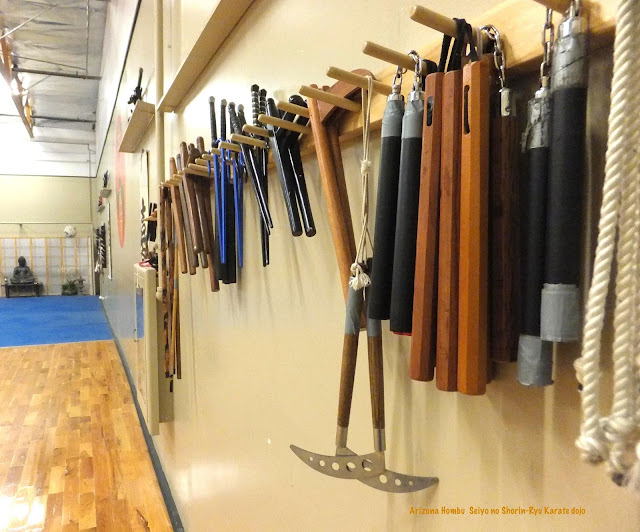
Along with karate (empty hand) training, Seiyo Shorin-Ryu students learn kobudo – the art of ancient weapons. Weapons in our curriculum include bo (6-foot staff), hanbo (half-staff), kobuton (short stick), nunchaku, sai, tonfa, kibo (expandable baton), kuwa (hoe), kumade (rake), kuai (cane), kama, nitanbo, iku (oar), manrikigusari (weighted chain), surichin (weighted rope), nireki (two rakes), hari (fish hook), tekko (knuckle duster), kusarigama (sickle & chain) and others.
Seiyo Shorin-Ryu members also have the unique privilege of learning Samurai arts including iaido, naginatajutsu, jujutsu, sojutsu, bojutsu, and hojojutsu. These arts include training with katana (samurai sword), tanto (knife), naginata (pole arm), yari (spear), hojo (cord) and jujutsu.
 |
| Sketch of Gichin Funakoshi (船越
義珍) |
Self-defense training is very important and we train in defense against a variety of attacks. When a new technique is introduced tori (the attacker) must begin by give and take until uke (defender) learns the technique, then tori should become more aggressive to provide more resistance and speed, but always keeping in mind safety and self-confidence issues. Tori must also remember that he or she is not being struck with an actual atemi (distracting strike) that assists uke in escapes. Our association also provides self-defense training for the lay-person through clinics and classes.
 |
Ryan uses tekubi waza on Dr. Adam
during training at Hombu in
Mesa, Arizona |
Sooner or later, all of our students break rocks. This is a very minor part of karate, but a confidence builder. After teaching karate for more than 40 years, I’ve only had one student unable to break a rock – it was a barrier that this person built for herself and could not overcome even though this person was capable. When breaking boards, we do not pick plywood to break (or tree limbs), so with rocks, we look for good flat, limestone and/or sandstone. So in a sense, it helps to be a geologist.
For a few students, special miegakure (hidden) techniques are taught including kotekitae (kotekikai) (body hardening) and tein hsueh (vital point strikes) are taught to help us master hitotsuki hitogeri (one strike one kick knockouts).
The majority of classes taught in our school are taught to adults and families. Each of our dojos is different: some focus on families, others on adults, and some have kid’s classes and some have a mix of classes.
 |
Dai-Shihan Gewecke of the Gillette, Wyoming dojo breaks rocks
during our Spring geology 101 training at the University of
Wyoming in Laramie.
|


.jpg)
%2B-%2BCopy.JPG)
.JPG)


